
Please Choose Your Language
Views: 0 Author: Site Editor Publish Time: 2026-10-13 Origin: Site
Manual grinding brings escalating labor costs and unpredictable finishing quality. Relying on hand tools creates dangerous workflow bottlenecks. Fabricators need a faster, more reliable solution to maintain profit margins. A sheet metal edge deburring machine acts as an automated system designed to remove burrs, round edges, and surface-finish laser-cut, punched, or sheared parts in a single or dual pass. It defines your finishing process not just mechanically, but commercially. Upgrading transforms unpredictable labor expenses into a fixed, predictable capability. This evaluation guide provides production managers and technical buyers with a transparent framework. You will learn how to evaluate various machine types. We will help you assess return on investment and mitigate implementation risks effectively. Discover how automation directly impacts your shop floor efficiency.
Transitioning to a metal deburring machine shifts finishing from a variable labor cost to a fixed, predictable process.
Machine selection hinges on part geometry, material (e.g., stainless vs. aluminum), and whether single-sided or double-sided processing is required.
The most reliable procurement step is conducting a time-study and sample run with your actual shop parts.
Hand-grinding hides massive operational costs. The limits of manual processing become obvious during high-volume production. High consumable turnover eats directly into your profits. Operators quickly wear out flap discs and grinding wheels. Manual edge quality fluctuates wildly from part to part. Operators frequently scratch delicate surfaces. This remains a common pain point for stainless steel sheets. Hand tools easily gouge expensive materials.
Quality and safety standards demand automated solutions. Automated edge rounding prevents severe handling injuries. Sharp edges easily slice through protective gloves. Smooth radiused edges ensure proper paint and coating adhesion. Paint naturally pulls away from sharp corners. This causes premature corrosion and coating failure. Strict aerospace and medical components demand exceptionally tight tolerances. Automated finishing meets these precise standards every single time.
Upgrading delivers distinct success criteria. You can identify several primary return-on-investment drivers. First, you reallocate skilled labor. Move workers from tedious grinding to higher-value welding or assembly. Second, facilities see increased throughput per hour. Machines process multiple parts simultaneously. Finally, automated systems drastically reduce scrapped or reworked parts. Predictable outputs guarantee better material utilization.
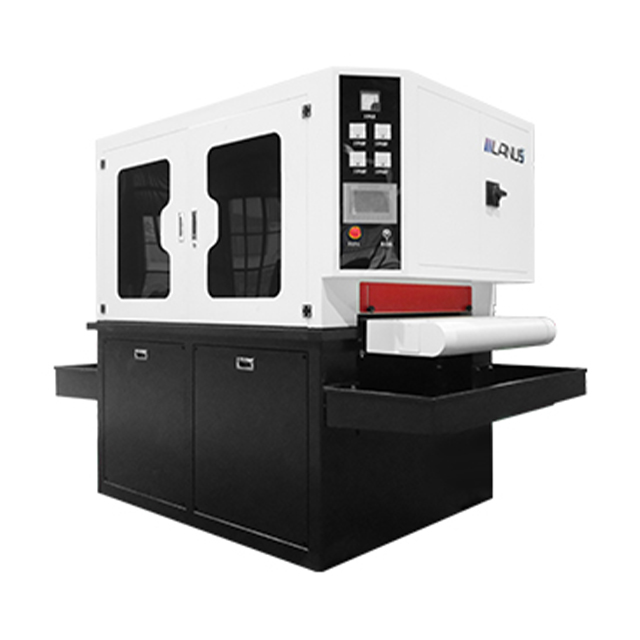
Modern equipment offers diverse processing configurations. You must understand how these mechanics align with your production flow. We compare single-sided and double-sided processing first. Traditional top-down processing finishes one face at a time. This requires operators to manually flip parts. Handling heavy steel plates twice wastes valuable time. Double-sided machines finish both sides simultaneously. They utilize top and bottom abrasive heads. They effectively halve your handling time. Throughput doubles instantly.
You must also choose between dry and wet systems. Each configuration serves a specific operational purpose.
Dry Systems: Standard use cases fit perfectly here. They process carbon steel or uniform material batches efficiently. Dry units offer significant footprint advantages. They require less floor space than wet alternatives. However, you must install integrated dust collection. Combustible dust compliance remains strictly mandatory. Dry metal dust poses severe explosion risks.
Wet Systems: Mixed-metal processing necessitates wet systems. Running aluminum and steel together creates severe fire hazards. Thermite reactions occur when these dusts mix. Wet systems extinguish sparks instantly. They use a coolant mixture to capture dust safely. They also extend abrasive belt life. The fluid keeps cutting surfaces cool and lubricated.
Keep your processing goals clear. Choose double-sided machines for high-volume plate processing. Select wet systems if your shop frequently cuts reactive metals. Always verify your dust collection strategy before purchasing a dry machine.
Manufacturers engineer different abrasive heads for specific tasks. No single head performs every finishing operation perfectly. You must match the machine type to your primary workflow.
Wide Belt Machines work best for heavy slag removal. They utilize continuous abrasive belts over a contact roller. They excel at straight-line grain finishing. However, note their limitations. Wide belts struggle to provide uniform edge rounding. They primarily cut on the vertical axis.
Rotary Brush Systems utilize spinning abrasive nylon bristles. They are ideal for multi-directional edge rounding. The flexible bristles hit edges from all angles. They access hard-to-reach contours easily. They process parts without removing flat surface coatings. You can safely run galvanized or PVC-coated sheets. The brushes only interact with the raised edges.
Disc and Orbital Machines feature top-down spinning pads. Focus on their utility for smaller parts. They provide aggressive, localized burr removal. They apply concentrated pressure on heavily burred edges. Many shops use them for precision parts.
Hybrid and Multi-Head Systems dominate modern fabrication shops. They combine belts and brushes in a single machine chassis. You address vertical burrs and lateral edge rounding in one pass. The first wide belt removes heavy dross. The subsequent rotary brushes radius the edges perfectly. This eliminates secondary operations.
Machine Type | Primary Function | Best Used For | Notable Limitations |
|---|---|---|---|
Wide Belt | Heavy slag removal, graining | Thick plasma/flame cut parts | Poor lateral edge rounding |
Rotary Brush | Multi-directional rounding | Coated sheets, complex contours | Cannot remove heavy vertical dross |
Disc / Orbital | Aggressive localized finishing | Small precision components | Slower feed rates |
Hybrid / Multi-Head | Comprehensive finishing | High-mix laser cut parts | Requires larger facility footprint |
Selecting the correct system requires strict technical evaluation. You cannot guess your way to the right purchase. Follow a structured approach to shortlist vendors.
Analyze Part Specifications: Map machine capabilities to your exact parts. Define your minimum and maximum part sizes. Small parts require vacuum beds or magnetic tracks. Consider material thicknesses carefully. Match the machine to specific thermal processes. Laser cut burrs differ entirely from heavy plasma cut slag.
Measure Footprint and Facility Integration: Address spatial constraints proactively. Measure the core machine footprint accurately. Factor in required infeed and outfeed clearance. Long sheets require massive loading zones. Do not forget the auxiliary dust extractors. They often require as much space as the machine itself.
Calculate Consumable Economics: Evaluate abrasive belt and brush lifespan. Do not focus solely on initial capital. Frame consumable cost per hour as a critical metric. High-quality ceramic belts cost more upfront. However, they process three times the linear footage. Use this metric for comparing vendors accurately.
Assess Changeover Efficiency: Measure media swapping time. Switching between different materials costs valuable production time. Quick-change brush systems keep your workflow moving. Avoid machines requiring complex tool setups for simple grit changes.
Do not compromise on your core requirements. A deburring machine must fit your physical space and operational budget. Ask vendors for explicit consumable lifespan data.
Buying the equipment marks only the beginning. Successful implementation requires careful planning. You must navigate several adoption risks to achieve true efficiency.
Operator training remains absolutely vital. Operation is largely automated today. However, setting the machine correctly requires baseline technical competence. Operators must determine the correct pinch roll pressure. They must calculate optimal feed speeds. Choosing the wrong abrasive grit ruins parts quickly. You need comprehensive vendor training during installation.
Compliance and safety require strict attention. We must emphasize NFPA and OSHA regulations. Fully compliant dust collection systems are non-negotiable. Processing reactive metals like aluminum demands strict safety protocols. Failing to isolate combustible dust results in catastrophic facility fires. Always consult local safety inspectors before commissioning dry systems.
Understand your maintenance assumptions clearly. Prevent machine downtime with rigorous routine maintenance. You must dress the conveyor belts regularly. Uneven conveyor wear causes inconsistent finishing. Bearing lubrication keeps the high-speed heads running smoothly. Sensor calibration ensures consistent thickness detection. Neglecting these tasks guarantees premature equipment failure. Build a preventive maintenance schedule immediately upon installation.
Running aluminum and steel through the same dry filter system.
Attempting to process parts smaller than the minimum pinch-roller distance without a vacuum bed.
Ignoring daily dust bin emptying procedures.
Using overly aggressive grits to speed up processing, resulting in ruined surface finishes.
The right metal deburring machine solves specific workflow bottlenecks seamlessly. It does not act as a blanket cure-all for poor cutting parameters. It elevates your shop floor productivity tremendously. Transitioning to automated finishing requires careful mechanical and spatial evaluation. Your final decision should reflect your specific material mix and volume demands.
Take actionable next steps today. Isolate your three to five most problematic parts. Calculate your current manual finishing costs accurately. Reach out to shortlisted manufacturers with this data. Request a live sample processing demonstration using your actual parts. This empirical proof ensures you make a profitable, long-term equipment investment.
A: Yes. Modern systems process stainless steel flawlessly. You use specialized rotary brushes designed for surface preservation. These brushes radius the edges without aggressive downward pressure. Furthermore, you can use PVC-coated sheets. The brushes target the exposed metal edges while leaving the protective film completely intact.
A: Deburring strictly removes sharp protrusions and vertical slag left by cutting processes. It simply flattens the edge. Edge rounding goes further. It creates a defined, smooth radius along the metal corner. This specific radius prevents handling injuries and ensures paint or powder coating adheres securely.
A: Hourly costs vary based on machine size and application. You calculate this by combining three main factors. First, measure average electricity consumption. Second, factor in the allocated operator labor time. Third, track your abrasive wear per hour. High-production ceramic abrasives reduce long-term hourly costs.
A: Single-purpose machines struggle with both extremes. You need a multi-head configurable system. A hybrid machine uses a rigid wide belt to knock down heavy plasma slag. You can then disengage the belt and use rotary brushes for delicate, thin laser-cut parts safely.


