
Views: 165 Author: Site Editor Publish Time: 2026-06-17 Origin: Site
Transitioning from manual edge finishing to automated deburring is a critical step in scaling sheet metal production. Selecting the wrong equipment, however, often introduces new bottlenecks and costly inefficiencies. You need a highly reliable system to ensure smooth, uninterrupted operations. For facility managers and production engineers, evaluating a finishing system requires careful analysis. You must balance edge quality requirements against daily operational realities. Floor footprint, consumable expenses, and your specific material mix play major roles in this decision. This guide breaks down the objective criteria needed to evaluate, shortlist, and procure the perfect machine. We will explore processing goals, wet versus dry systems, and safety compliance. By the end, you will know exactly how to assess vendors for your specific fabrication environment. Implementing the right solution ultimately protects your bottom line, elevates product quality, and significantly improves overall workplace safety.
Material dictates technology: Mixed-metal runs and combustible dust risks (e.g., aluminum) are the primary drivers when choosing between wet and dry deburring systems.
Total Cost of Ownership (TCO) extends beyond the machine: Abrasive belt lifespan, power consumption, and maintenance downtime often exceed the initial capital expenditure.
Sample testing is non-negotiable: Never finalize a purchase without requiring the vendor to process your actual parts and provide a verifiable time study.
Edge rounding vs. deburring: Clarifying whether your process requires simple burr removal, heavy slag removal, or precision edge rounding dictates the necessary brush and belt configurations.
Manual grinding causes highly inconsistent parts. It drives up labor costs rapidly and creates major safety liabilities for your workers. Repetitive strain injuries occur frequently during manual edge finishing. Automation must solve these exact issues. It should never introduce new failure points into your workflow. Before evaluating any specific deburring machine, you must define what success actually looks like for your facility.
Different parts require entirely different finishing approaches. We categorize these processing goals into four distinct areas:
Primary Deburring: Removing thick, vertical burrs left by laser, plasma, or punch presses. These burrs form when molten metal solidifies on the bottom edge of a cut.
Edge Rounding: Creating a specific, measurable radius along the part. Paint naturally pulls away from sharp 90-degree corners due to surface tension. A rounded edge ensures strong paint adhesion and improves ergonomic safety for downstream assembly workers.
Oxide Layer Removal: Preparing laser-cut edges for subsequent welding stages. Oxygen-assisted laser cutting leaves a brittle oxide scale. Welding over this scale causes porosity and weak joints.
Surface Finishing: Achieving specific directional grains or a highly polished aesthetic look, particularly important for consumer-facing stainless steel appliances.
You must set measurable baselines before making a purchase. Document your current manual processing time per part. Track your exact scrap rates caused by manual scratching or inconsistent grinding. Define your desired automated throughput speed in feet per minute.
Best Practice: Always involve your quality assurance team when defining these baselines. They understand exactly what downstream coating and welding processes require to succeed.
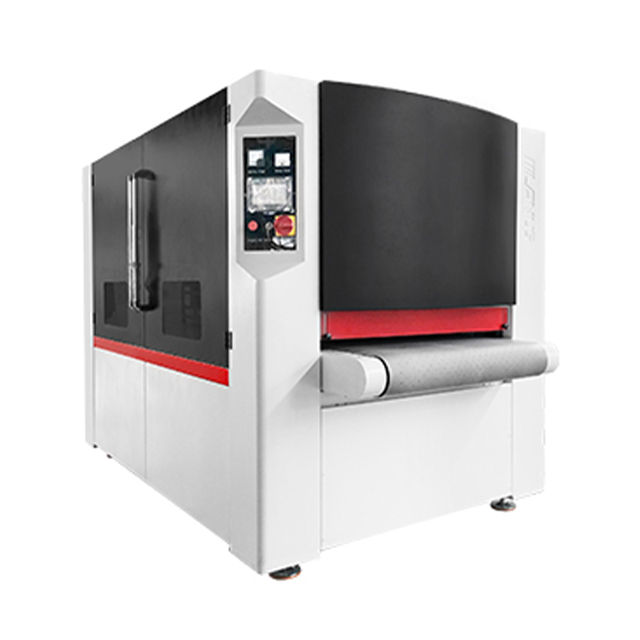
Part specifications heavily influence your equipment choice. You must determine your minimum and maximum part dimensions early. Handling very small parts often requires specific vacuum or magnetic conveyor beds. Standard friction belts easily drop small components, causing jams and internal machine damage. You also need to assess sheet thickness variances. Modern systems feature highly sensitive auto-calibration tools. They adjust automatically to slight thickness changes between different sheets, preventing over-grinding.
Material compatibility represents another crucial dimension. Evaluate your exact processing needs carefully. Do you run mild steel, stainless steel, aluminum, or copper? You must manage cross-contamination risks effectively when running multiple materials through a single metal deburring machine. Embedding mild steel particles into a stainless steel sheet causes rapid galvanic corrosion. Mixing materials often degrades surface quality and ruins expensive parts.
Machine configuration and internal tooling directly dictate processing performance. Compare heavy-duty belt heads against rotary brush heads. Belts handle heavy slag and rigid burrs exceptionally well. Rotary brushes excel at delicate edge rounding and oxide removal without altering the flat surface of the sheet. Consider the ease of access for routine tooling changeovers. Quick changes minimize operator downtime significantly.
Tooling Configuration |
Primary Mechanical Function |
Ideal Application Scenarios |
|---|---|---|
Wide Abrasive Belts |
Heavy vertical burr and slag removal |
Thick plasma and flame-cut steel plates |
Multi-Directional Rotary Brushes |
Precision 360-degree edge rounding |
Paint preparation and aerospace components |
Scotch-Brite Finishing Rollers |
Surface blending and linear graining |
Stainless steel appliance panels and enclosures |
Wire Brush Cylinders |
Aggressive oxide layer fracturing |
Laser-cut steel parts requiring clean weld seams |
Common Mistake: Buying a single-head machine for a multi-step finishing process. This forces operators to run parts through multiple times. It destroys your throughput goals and dramatically increases labor handling time.
Choosing between wet and dry processing changes your entire operational footprint. This decision dictates your environmental compliance requirements, consumable spending, and daily maintenance routines.
Dry systems fit best in facilities processing primarily one material type. For example, shops running exclusively mild steel benefit greatly from dry processing technology.
Advantages: They carry a noticeably lower initial setup cost. They integrate easily into continuous, dry production lines. You completely avoid complex wastewater management protocols.
Implementation Risks: They require robust, highly compliant dust collection systems. Mixing aluminum and steel dust creates severe fire and explosion hazards. This dangerous thermite reaction risk requires strict operational discipline and intensive machine cleaning protocols.
Wet systems fit best in high-mix manufacturing environments. Aerospace applications and heavy aluminum processing facilities rely heavily on wet processing to ensure safety and precision.
Advantages: They naturally eliminate combustible metal dust risks. Flowing coolant extends abrasive belt life significantly by washing away debris. They prevent thin parts from warping due to excessive frictional heat.
Implementation Risks: You must manage dirty coolant and rust-inhibitor chemistry daily. They often require secondary part-drying processes before downstream painting or welding can occur.
Feature / Requirement |
Dry Deburring Systems |
Wet Deburring Systems |
|---|---|---|
Combustible Dust Risk |
High (Requires strict extraction and isolation) |
Eliminated entirely by water encapsulation |
Initial Capital Cost |
Generally Lower |
Generally Higher (Includes filtration systems) |
Consumable Lifespan |
Standard wear rates |
Extended (Coolant reduces heat and loading) |
Part Temperature |
Can get very hot, risking micro-warpage |
Kept cool and dimensionally stable |
Maintenance Focus |
HEPA filter changes, ductwork inspections |
Coolant filtration, sludge removal, chemistry checks |
Facility integration requires precise spatial planning. Assess your actual floor space requirements meticulously. You must include space for long in-feed and out-feed tables. Operators need enough physical clearance around the unit for routine maintenance access. Tight spaces lead to neglected maintenance schedules, which ultimately causes premature machine failure.
Compliance and safety standards dictate strict installation requirements. You must meet OSHA and NFPA standards for combustible metal dust management. NFPA 484 compliance is absolutely critical for dry machines processing volatile metals like aluminum or titanium. Consider dedicated noise reduction enclosures. Heavy grinding generates significant decibel levels. You must protect your workers' hearing. Install proper operator safety barriers to prevent pinch-point injuries around the conveyor beds.
Automation scalability ensures your capital investment lasts for decades. Plan for future factory growth today. Ensure the system possesses the capability to integrate robotic part loading and unloading. Connect it seamlessly to your existing intelligent conveyor systems. Modern manufacturing facilities increasingly rely on collaborative robots (cobots) to handle heavy metal sheets. Your finishing equipment must communicate effectively with these automated loaders.
Uncovering hidden costs ensures accurate financial modeling. You must model the lifetime operating expenses of all system consumables. Track abrasive belts, rotary brushes, and daily coolant expenses. Factor in expensive HEPA filter replacements for dry dust collection systems. These ongoing expenses accumulate rapidly over a five-year period. A machine with a lower upfront price often costs significantly more to operate annually.
Labor reallocation presents a massive financial opportunity for your facility. Calculate the true financial impact of moving manual grinders elsewhere. Shift these workers to higher-value welding, press brake operation, or assembly tasks. This strategy boosts overall factory throughput. It maximizes your existing skilled workforce efficiently while eliminating the bottleneck of manual edge finishing.
The vendor validation process represents your final crucial step before issuing a purchase order. You must approach this analytically.
Action: Send a variety of your worst-case-scenario parts to your shortlisted vendors. Include parts with heavy dross, small complex geometries, and materials prone to scratching.
Requirement: Demand an unedited video showing your exact parts running through the machine. Ask for a thoroughly documented time study. Request a precise report detailing the exact consumable wear experienced during your run.
Contractual Protection: Ensure all performance guarantees tie directly to these sample test results. Protect your capital investment contractually before signing any final agreements.
Investing in automated edge finishing represents a high-stakes operational decision. It directly impacts your downstream assembly efficiency, coating adhesion quality, and overall worker safety. You cannot afford to guess when integrating this technology into your sheet metal line. Always base your final equipment decision on verifiable, real-world sample tests rather than generic sales brochures.
Build strict operational cost models rather than simply comparing surface-level feature lists. Prioritize clear safety compliance, especially regarding combustible dust extraction and noise mitigation. We encourage you to audit your current manual grinding costs today. Start gathering your most difficult, labor-intensive sample parts for comprehensive vendor testing immediately. By taking a data-driven approach, you ensure a smooth installation and an immediate boost to your production capabilities.
A: You must protect the surface early. Apply PVC-coated protective films during upstream cutting processes. Use specialized vacuum conveyors to prevent micro-shifting inside the machine. Finally, select the correct non-woven abrasive grades to maintain the pristine finish without digging aggressively into the metal.
A: Yes, but you need a multi-head configuration. A heavy-duty grinding belt operates first to remove thick plasma dross. Following that, softer rotary brushes step in to handle finer laser-cut edge rounding. This combination ensures smooth finishes across different cutting methods.
A: Standard friction belt beds often struggle with parts smaller than 2x2 inches. Small items can easily slip or fly off during grinding. We highly recommend using sticky belts, magnetic chucks, or high-suction vacuum tables to securely hold smaller components during processing.
A: We strictly advise against this practice. Mixing these dusts creates severe thermite spark and explosion hazards. If you must run both, you need rigorous, deep-cleaning protocols between every single material run. For high-mix environments, wet systems remain the safest and most efficient recommendation.


