
Please Choose Your Language
Views: 184 Author: Site Editor Publish Time: 2026-02-21 Origin: Site
In the vast ecosystem of modern manufacturing, the polishing machine stands as a critical bridge between raw fabrication and the final, market-ready product. At its core, a polishing machine is a mechanical device designed to refine the surface of a material—most commonly metal, but also plastic, wood, or glass—using controlled abrasion and friction. While many people associate "polishing" with simply making an object shiny, the industrial definition is far broader. It encompasses grinding, sanding, deburring, and smoothing to achieve specific technical specifications.
For a manufacturer, the polishing machine is not just a luxury for aesthetics; it is a necessity for functionality and safety. A raw metal plate, after being cut by a laser or stamped by a heavy press, often possesses sharp edges, surface oxidation, or microscopic irregularities. If left untreated, these defects can lead to structural failure, poor paint adhesion, or safety hazards for handlers. The polishing machine systematically removes these imperfections, ensuring that every component meets the rigorous standards required by industries ranging from automotive to medical equipment.
Surface quality is measured through various metrics, the most common being Roughness Average (Ra). A high-quality polishing machine allows a factory to consistently hit specific Ra targets, which is vital for parts that require high precision. In the medical field, for example, surgical instruments must be polished to a mirror finish to prevent bacteria from colonizing microscopic pits in the metal. In the aerospace sector, even the smallest surface scratch can become a stress point that leads to fatigue cracks under the extreme pressures of flight.
Beyond technical performance, there is the undeniable factor of perceived value. Whether it is a kitchen appliance, a piece of architectural trim, or a high-end automotive part, the quality of the finish is the first thing a customer notices. A uniform "brushed" texture or a flawless mirror shine signals craftsmanship and quality control. Therefore, investing in the right polishing machine is a strategic decision that impacts both the structural integrity and the marketability of a product.
The history of surface finishing is as old as metalworking itself. For centuries, polishing was a grueling manual task. Craftsmen used stones, sand, and animal fats to slowly wear down surfaces by hand. This process was not only slow but also physically demanding and highly inconsistent. The quality of the finish depended entirely on the skill and stamina of the individual worker.
With the advent of the Industrial Revolution, the first mechanical polishing machines appeared. These were often simple rotating wheels powered by steam or water. While they increased speed, they still required a high degree of manual intervention. The operator had to hold the workpiece against the spinning wheel, which was dangerous and often led to uneven results. It wasn't until the mid-20th century that we saw the rise of automated polishing lines capable of processing thousands of identical parts with minimal human oversight.
Today, the industry has transitioned into the era of high-tech automation. Modern polishing machines are sophisticated systems integrated with sensors, programmable logic controllers (PLCs), and even robotic interfaces. These machines can handle complex three-dimensional shapes that were previously impossible to polish mechanically. By using CNC (Computer Numerical Control) technology, manufacturers can program the exact pressure, speed, and path of the polishing head, ensuring that every single part produced is an exact replica of the master design.
This evolution has been driven by the need for extreme precision and the rising cost of skilled labor. In modern high-scale production, manual finishing is no longer viable. Companies like LANUSS have been at the forefront of this transition, developing machines that combine heavy-duty manufacturing force with delicate industrial technology to meet the needs of a global market.
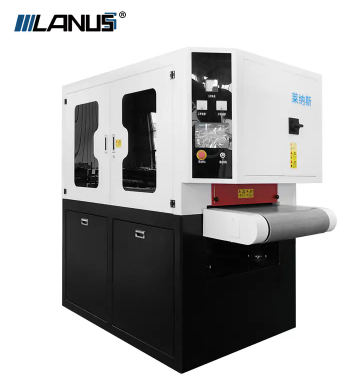
The operation of a polishing machine is rooted in the physics of material removal. Unlike a cutting machine that removes large chunks of material, a polishing machine works through micro-cutting. Abrasive grains, bonded to a belt, disc, or brush, act as thousands of tiny knives that shave away the highest peaks of the material's surface. As these peaks are leveled, the surface becomes smoother and more reflective.
This process requires a delicate balance of three primary variables: speed, pressure, and abrasive grit. The speed of the machine's motor determines how many times the abrasive grains contact the surface per second. The pressure dictates how deep those grains penetrate the material. Finally, the grit size—ranging from coarse (low numbers) to fine (high numbers)—determines the aggressiveness of the cut. An industrial-grade machine must be able to modulate these variables with extreme precision to avoid "burning" the metal or warping thin sheets through excessive heat generation.
One of the most significant challenges in industrial polishing is maintaining consistent pressure across the entire surface of a workpiece. If a machine applies too much force to one area, it can create a "dip" or alter the dimensional accuracy of the part. Advanced polishing machines solve this by using pneumatic or electronic pressure sensors. These systems allow the grinding heads to "float" over the material, adjusting their height in real-time to compensate for slight variations in the thickness of a metal plate.
Friction management is equally important. Friction generates heat, and heat is the enemy of metal finishing. Excessive heat can cause thermal expansion, leading to warping or changes in the metallurgical properties of the alloy. High-end polishing machines often incorporate sophisticated cooling systems, such as wet-grinding interfaces where a lubricant or coolant is sprayed onto the material during the process. This not only keeps the workpiece cool but also helps wash away the removed metal dust, preventing the abrasive belts from becoming "clogged" and losing their effectiveness.
Industrial polishing machines are not one-size-fits-all. They are categorized based on their abrasive delivery system and the type of workpieces they are designed to handle. Understanding the differences between these types is essential for any factory looking to optimize its production line.
Wide-belt machines are the workhorses of the sheet metal industry. They feature large, continuous abrasive belts that wrap around heavy-duty rollers and tensioning cylinders. These machines are designed for flat surfaces, making them ideal for processing large metal panels, architectural sheets, and flat structural components. A wide-belt machine can often perform multiple tasks in a single pass: the first head might use a coarse belt for heavy grinding, while the second and third heads use finer belts to achieve a specific satin or "brushed" finish.
In many applications, such as the production of stainless steel appliances or elevator panels, the wide-belt machine is used to create a "linear drawing" effect. This involves creating consistent, parallel lines across the surface of the metal, which provides an aesthetic appeal while also making the surface more resistant to visible fingerprints and scratches.
For parts with complex geometries, holes, or irregular edges, a flat belt is often insufficient. This is where disc and planetary brush systems excel. These machines use rotating abrasive discs or brushes that can move in multiple directions simultaneously. A planetary system, for instance, features multiple brushes that rotate on their own axes while the entire head rotates in a larger circle.
This multi-directional movement ensures that every edge and hole of a complex part—such as a laser-cut gear or a stamped automotive bracket—is reached evenly. These machines are primarily used for deburring and edge rounding rather than surface leveling. They are essential for ensuring that parts are safe to handle and that they fit together perfectly during the assembly process.
A significant portion of the work done by industrial polishing machines is actually deburring. When metal is cut using thermal processes like laser, plasma, or flame cutting, or mechanical processes like stamping, a "burr" is often left behind. A burr is a small, sharp ridge of displaced material that remains attached to the edge of the cut.
Deburring is the process of removing these sharp edges. If burrs are not removed, they can cause serious injuries to workers, interfere with the fitment of parts, and lead to early failure of the component due to stress concentrations. Specialized deburring machines use a combination of abrasive belts to remove the top-level slag and flexible brushes to "roll over" the edges, ensuring the part is completely smooth.
In addition to burrs, thermal cutting processes like flame or plasma cutting often leave behind "slag"—heavy, hardened droplets of melted metal. Removing slag is a much more aggressive process than standard polishing. Heavy-duty machines, such as the LSB series from LANUSS, are designed specifically for this task. They use high-torque motors and aggressive abrasive wheels to strip away the slag and prepare the surface for subsequent machining or painting.
Similarly, laser cutting can sometimes leave "splash stains" or dross on the underside of the cut. A polishing machine equipped with the right abrasive media can remove these stains in a single pass, restoring the aesthetic and functional integrity of the part. This "one-time removal" capability is a major efficiency booster for modern factories.
Edge rounding is the process of creating a specific radius (an "R-arc") on the edges of a workpiece. This goes beyond simple deburring. While deburring removes the sharp point, edge rounding creates a smooth, curved transition from the flat surface to the side of the part. This is a critical requirement in many high-end industries, particularly automotive and aerospace.
The primary technical reason for edge rounding is paint and coating adhesion. When a part with a sharp 90-degree edge is painted, the liquid coating tends to pull away from the sharp point as it dries, leaving a very thin layer of protection at the corner. This thin spot is the first place where rust and corrosion will start. By creating a smooth R-arc using a planetary brush polishing machine, manufacturers ensure that the protective coating is thick and uniform across the entire perimeter of the part.
Beyond corrosion resistance, edge rounding significantly improves the ergonomics of a product. Any part that will be handled by a human—whether it is a tool, a handle, or a piece of furniture—should have rounded edges to prevent cuts and improve comfort. In the automotive industry, many interior and exterior components must meet strict "radius" requirements to pass safety inspections. A specialized polishing machine like the LSD series is the only way to achieve these consistent results on a mass-production scale.
The physics of polishing changes significantly depending on the material being processed. A machine that is perfectly tuned for stainless steel might fail miserably when tasked with polishing aluminum or wood. Professional manufacturers must understand these nuances to provide effective "tailor-made" solutions.
Aluminum is a "soft" metal compared to steel, but it presents unique challenges. Because of its low melting point, aluminum dust can easily "load" or clog an abrasive belt. Once a belt is clogged, it no longer cuts; instead, it generates excessive friction and heat, which can warp the aluminum sheet. Furthermore, aluminum dust is highly flammable.
To safely polish aluminum, machines must be equipped with specialized dust extraction systems or "wet" filtration units. The abrasive media must also be carefully selected; silicon carbide is often preferred over aluminum oxide for non-ferrous metals because it is sharper and generates less heat. Modern "intelligent" machines allow operators to quickly change settings to accommodate different materials, ensuring maximum versatility on the factory floor.
Industrial polishing is not limited to metal. The same mechanical principles are applied to wood, PCB (Printed Circuit Boards), and even certain plastics. In the PCB industry, polishing machines are used to ensure the surface is perfectly flat and clean before the copper layers are applied. In the furniture industry, wide-belt sanding machines are the standard for achieving smooth surfaces on large wooden panels. The ability of a machine to handle both metallic and non-metallic materials is a hallmark of a versatile, high-end manufacturer like LANUSS.
Investing in a high-quality polishing machine is a strategic economic decision. While the initial capital expenditure can be significant, the long-term Return on Investment (ROI) is often undeniable. The primary driver of this ROI is the dramatic reduction in labor costs.
Manual polishing is one of the most expensive and slowest steps in the manufacturing process. By replacing a team of manual polishers with a single automated LSG or LSP series machine, a factory can increase its throughput by several hundred percent. A machine does not get tired, does not take breaks, and maintains the exact same quality from the first minute of the shift to the last. This consistency reduces the "scrap rate"—the number of parts that must be thrown away due to surface defects—saving thousands of dollars in material costs.
Modern polishing machines are designed for longevity and ease of maintenance. Features like "Efficient Response" systems allow manufacturers to diagnose and solve problems quickly. By using remote operations and maintenance technology, technicians can often fix software issues or calibration errors without needing to visit the factory in person.
Furthermore, these machines are designed to be energy-efficient. High-efficiency motors and intelligent power management systems ensure that the machine only uses the energy it needs for the specific task at hand. When you combine reduced labor, lower scrap rates, and efficient power usage, an automated polishing machine often pays for itself within the first year of operation.
As we move into the era of Industry 4.0, the polishing machine is becoming part of a fully integrated, "smart" factory. This involves the use of robots, manipulators, and advanced conveying equipment to achieve truly unmanned operations.
In a fully automated line, a robotic arm might pick up a raw part from a pallet, place it onto the conveyor of the polishing machine, and then rotate the part so that both sides are finished. Sensors inside the machine can track the wear on the abrasive belts in real-time, automatically adjusting the tension and pressure to compensate. When the belt reaches the end of its life, the machine can alert the operator or even pause production to prevent quality issues. This level of intelligence ensures that the "pursuit of value" is built into every step of the process.
Because every factory has different needs, the trend in the industry is toward "One-Stop Service." This means the manufacturer doesn't just sell a machine; they provide a complete solution, including the automation, the dust extraction, the abrasives, and the after-sales support.
Customization is the key. A manufacturer of automotive fasteners has very different requirements than a company making large industrial pumps. By offering "professional tailor-made" solutions, manufacturers like LANUSS ensure that the machine is a perfect fit for the client's specific production goals. This holistic approach simplifies the procurement process and ensures that the client gets the maximum value from their investment.
Industrial manufacturing has a responsibility to protect both its workers and the environment. Polishing machines, if not properly managed, can be noisy and produce dangerous amounts of dust. High-end equipment must meet strict environmental standards to be sold in the world's "best-selling countries."
Modern machines are fully enclosed to contain noise and are equipped with high-efficiency particulate air (HEPA) filtration systems. These systems capture 99% of the metal dust at the source, preventing it from entering the factory atmosphere. For materials like aluminum or magnesium, "wet" scrubbing systems are used to neutralize the flammable dust in a water bath.
Cleaning and drying equipment is also often integrated into the polishing line. After a part is polished—especially in a wet-grinding process—it must be cleaned and dried to prevent oxidation. By integrating these steps, the manufacturer ensures that the parts are ready for the next stage of production immediately upon leaving the machine. This focus on "Responsibility" is a core value that defines the most trusted factories in the world.
In conclusion, a polishing machine is far more than just a tool for making metal shiny. it is a complex, high-precision instrument that is essential for modern manufacturing. From the basic definition of surface refinement to the advanced integration of robotics and Industry 4.0, these machines represent the pinnacle of industrial technology.
Whether it is removing burrs from a laser-cut part, achieving a perfect mirror finish on a medical implant, or creating a rounded R-arc for superior paint adhesion, the polishing machine is the final guardian of a product's quality. As manufacturing continues to evolve, the demand for even higher precision, greater automation, and better sustainability will continue to drive innovation in this field. For businesses around the world, choosing the right polishing machine is the first step toward achieving "Professionalism, Responsibility, and Sharing" in their own products. In the end, the quality of the surface is the ultimate standard of excellence, and the polishing machine is the tool that makes that excellence possible.


