
Please Choose Your Language
Views: 135 Author: Site Editor Publish Time: 2026-03-05 Origin: Site
In the contemporary manufacturing landscape, the standard for "acceptable" surface quality has undergone a radical transformation. Industries such as aerospace, medical device manufacturing, and high-end automotive production no longer view surface finishing as a secondary, aesthetic process. Instead, it is recognized as a critical engineering phase that directly impacts the functional performance, longevity, and safety of a component. Achieving superior surface quality requires more than just a standard grinder; it demands the specialized capabilities of a high-precision sanding polishing machine. These machines are engineered to bridge the gap between raw, machined parts and the flawless, high-performance surfaces required by global quality standards.
The pursuit of superior surface quality is essentially a battle against microscopic irregularities. When a metal part is cut, cast, or forged, its surface is a landscape of peaks and valleys known as "asperities." These irregularities can lead to friction, premature wear, and the localized stress concentrations that cause fatigue failure. A high-precision sanding polishing machine uses advanced abrasive technology to systematically level these peaks, creating a surface that is uniform not just to the human eye, but at the micron level. As global competition intensifies, the ability to deliver these superior finishes consistently and efficiently has become a primary differentiator for leading manufacturing enterprises.
To understand how a high-precision sanding polishing machine achieves superior results, one must look at the mechanical and material science that governs the process. Unlike traditional manual grinding, where the pressure and angle are subjective, a precision machine operates within a strictly controlled environment. The core of this technology lies in the interaction between the abrasive belt or brush and the workpiece surface. In a high-precision system, every variable—from the linear speed of the abrasive belt to the tension and oscillation—is managed by sophisticated control algorithms.
High-precision sanding is characterized by its ability to perform "stock removal" and "surface refinement" simultaneously or in rapid succession. The machine must be rigid enough to handle the forces required to grind down heavy weld seams or laser-cut slag, yet delicate enough to provide a satin or mirror finish without removing too much material. This duality is achieved through the use of multi-head configurations. For example, a machine might feature a rigid contact roller for the initial heavy sanding, followed by a flexible planetary brush head for fine polishing and edge rounding. This sequential processing ensures that the surface is prepared correctly at every stage of the refinement journey.
The abrasive media is the "cutting tool" of the sanding polishing machine. High-precision machines utilize premium abrasives such as ceramic, zirconia, or silicon carbide grains, which are bonded to high-strength polyester or paper backings. The choice of abrasive is critical; for instance, ceramic grains are self-sharpening and ideal for high-pressure grinding on tough stainless steel, while silicon carbide is preferred for non-ferrous metals like aluminum due to its sharpness and lower heat generation.
Precision is further enhanced by the grit size progression. A high-precision workflow often begins with a coarse grit (e.g., P60 or P80) to level the surface, moving through medium grits (P120 to P180), and finishing with fine grits (P320 to P600 or higher). In a professional sanding polishing machine, the belt tensioning system is crucial. If the belt is too loose, it will "bounce" and create chatter marks; if it is too tight, it may break or cause excessive heat. Advanced machines use pneumatic tensioning and electronic tracking to ensure the belt remains perfectly centered and taut, providing a consistent cutting action across the entire width of the workpiece.
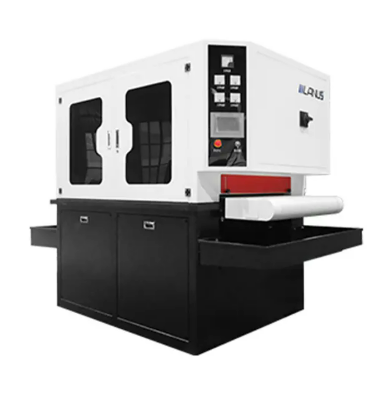
In the world of high-precision manufacturing, "quality" is defined by the Roughness Average, or Ra value. This is the arithmetic mean of the absolute values of the profile height deviations from the mean line recorded within the evaluation length. A lower Ra value indicates a smoother surface. For many industrial applications, achieving a specific Ra value is a contractual requirement. A high-precision sanding polishing machine is specifically designed to hit these targets with mathematical reliability.
Achieving a low Ra value (such as Ra 0.4 or 0.8) requires absolute control over the machine’s vibration and pressure. Any vibration in the machine’s frame or motor will be transferred to the workpiece as "waves" or "chatter," effectively ruining the precision of the finish. Manufacturers like LANUSS, with their 16,500-square-meter facility and 70+ technical patents, focus heavily on structural damping and high-precision spindle balancing to eliminate these vibrations. This allows the machine to maintain a steady contact between the abrasive and the metal, resulting in a surface that meets the most stringent international standards for smoothness and reflectivity.
Two of the most critical parameters in controlling Ra values are the "feed speed" (how fast the part moves through the machine) and the "linear speed" (how fast the abrasive belt is moving). If the feed speed is too fast, the abrasive does not have enough time to remove the peaks of the surface profile. If the linear speed of the belt is too slow, the abrasive "tears" the metal rather than cutting it cleanly.
High-precision sanding polishing machines use variable frequency drives (VFDs) to allow operators to fine-tune these speeds based on the material properties. For example, stainless steel generally requires a lower feed speed and a higher linear belt speed to achieve a high-quality "brushed" finish. By optimizing these ratios, a precision machine can produce a surface that is not only smooth but also possesses a specific aesthetic texture, such as the "N5" or "N10" finish often required in architectural sheet metal.
Superior surface quality is the result of thousands of small engineering decisions. In a high-precision sanding polishing machine, these decisions manifest as advanced mechanical features. One of the most important is the pressure regulation system. Traditional machines use simple springs or manual adjustment screws, which are prone to inconsistency. In contrast, modern precision machines utilize pneumatic "floating" heads.
These floating heads allow the abrasive unit to follow the natural contours of the workpiece with a constant, pre-set pressure. This is particularly vital for large metal plates that may have slight variations in thickness or flatness. Without a floating head, the machine would grind too deeply on high spots and miss low spots, resulting in an uneven finish. By using electronic sensors to monitor and adjust the pressure hundreds of times per second, high-precision machines ensure a perfectly uniform result across the entire area of the part.
Friction produces heat, and in surface finishing, heat is a major enemy of precision. Excessive heat can cause "blueing" or discoloration of stainless steel and can lead to thermal expansion, which alters the dimensions of the part. High-precision sanding polishing machines often incorporate "wet-grinding" systems to mitigate these risks.
In a wet-grinding setup, a specialized coolant or lubricant is sprayed onto the workpiece during the sanding process. This serves three functions: it cools the material, it lubricates the abrasive to reduce friction, and it washes away the metal dust. This prevents the abrasive belt from "loading" (clogging with metal particles), which would otherwise cause the belt to lose its cutting efficiency and generate even more heat. For materials like aluminum, which have a low melting point, wet-grinding is often the only way to achieve a superior, high-precision finish without damaging the surface integrity.
A superior surface is not just about the flat areas; it is also about the edges. A high-precision machine must address the burrs and sharp corners left behind by laser cutting, stamping, or waterjet cutting. This is where specialized series like the LSP and LSD come into play. A burr is a structural defect that can compromise the fitment of an assembly or pose a safety risk.
High-precision deburring involves removing the burr without changing the dimensions of the part. After the burr is removed, "edge rounding" or the "R-arc effect" is applied. This process creates a specific radius on the edge of the metal. While this might seem like a minor detail, it is essential for parts that will be painted or coated. Sharp edges cause paint to "pull back," leading to thin spots where corrosion can begin. By creating a uniform R-arc, the high-precision sanding polishing machine ensures that the protective coating is thick and durable across the entire component, significantly extending its service life in the field.
To achieve superior edge rounding on complex parts with internal holes and intricate geometries, high-precision machines utilize planetary brush systems. Unlike a belt that moves in a single direction, planetary brushes rotate on their own axes while simultaneously revolving around a central point. This creates a multi-directional abrasive action that "wraps" around every edge of the part, no matter how complex the shape.
This technology is a hallmark of high-end manufacturing. It allows a factory to process thousands of small, intricate parts—such as automotive fasteners or electronic casings—to the same high standard of edge quality. The 70+ patents held by LANUSS often cover the unique mechanical synchronization required to make these planetary systems both precise and durable under the stresses of continuous industrial operation.
The highest level of precision is achieved when human error is removed from the equation. High-precision sanding polishing machines are increasingly integrated with automation to achieve "unmanned operations." This involves the use of robots for loading and unloading, as well as sensors that monitor the "health" of the machine in real-time.
An automated system can detect when an abrasive belt is beginning to wear out by monitoring the spindle's power consumption. As a belt becomes dull, it requires more force to achieve the same cut. The machine’s PLC (Programmable Logic Controller) can identify this trend and alert the operator, or even automatically adjust the pressure to compensate for the wear until the belt can be replaced. This ensure that the "Superior Surface Quality" promised in the title is maintained from the first minute of the shift to the last, regardless of the operator's skill level.
Because every material and industry has different requirements, "one-size-fits-all" is not an option for high-precision finishing. This is why LANUSS emphasizes "Professional Tailor-Made" solutions. A company manufacturing surgical instruments in stainless steel requires a completely different machine configuration than one processing large aluminum panels for the aerospace industry.
High-precision equipment manufacturers provide a "One-Stop Service" that begins with a deep technical consultation. They analyze the client's material, their desired Ra value, their production volume, and their existing automation. By leveraging their cooperative network in over 20 countries, they can deliver a customized machine that is perfectly tuned for the client's specific application. This tailored approach is what allows small and medium-sized enterprises to achieve the same "Outstanding Quality" as famous multi-national corporations.
The demand for high-precision sanding polishing machines is driven by industries where failure is not an option. In the automotive sector, surface finish is critical for engine components, where smooth surfaces reduce friction and improve fuel efficiency. For exterior parts, the "Mirror Finish" achieved by precision polishing is a requirement for high-end luxury brands.
In the electronics industry, particularly in the production of PCBs (Printed Circuit Boards) and semiconductor components, the surface must be perfectly flat and free of any microscopic contaminants or scratches. The LSG series from LANUSS, designed for multi-material surfaces, provides the stability required for these delicate tasks. Similarly, in the food and beverage industry, stainless steel tanks and processing lines must have a specific "Sanitary Finish" to prevent bacterial growth, a task that only a high-precision machine can reliably perform.
Aerospace components are subject to some of the highest quality standards in the world. Every part must be deburred and polished to eliminate potential stress concentrators that could lead to fatigue cracks. High-precision sanding ensures that the grain structure of the metal is not disturbed while achieving the necessary smoothness.
In the medical field, orthopedic implants—such as titanium hip or knee replacements—must be polished to an extreme level of smoothness to ensure biocompatibility and reduce wear within the human body. These applications represent the pinnacle of surface finishing, and they are only possible with machines that combine advanced R&D with a "Responsibility" to 100% quality compliance.
While high-precision machines represent a higher initial investment than basic grinders, the economic return is significantly greater. The primary driver is the reduction in "cost per part." By automating the finishing process and achieving superior quality in a single pass, factories can drastically reduce their labor costs and their scrap rate.
In a manual finishing shop, it is common to have a 5-10% scrap rate due to over-grinding or inconsistent quality. A high-precision sanding polishing machine reduces this to nearly zero. Furthermore, the speed of these machines—supported by efficient conveying equipment and manipulators—allows for much higher throughput. When you combine higher quality, lower scrap, and faster production, the ROI (Return on Investment) is typically realized very quickly, often within the first 12 to 18 months of operation in a high-volume facility.
In a precision manufacturing environment, downtime is incredibly expensive. This is why "Efficient Response" is listed as a core advantage for leading manufacturers. The ability to respond to a technical inquiry within 2 hours and provide a solution within 24 hours is vital for maintaining production schedules.
By leveraging remote operations and maintenance, technicians can often calibrate or troubleshoot a high-precision machine in another country via the cloud. This global support network ensures that the machine continues to produce "Best-selling" quality regardless of where it is installed. For a company like LANUSS, selling to over 50 countries, this service infrastructure is as important as the machines themselves.
The future of superior surface quality lies in the integration of Artificial Intelligence (AI). We are already seeing the first generation of machines that can "see" the surface they are polishing. Using high-resolution cameras and machine learning algorithms, these systems can detect a surface defect—such as a scratch or a remaining burr—and automatically tell the machine to adjust its parameters to fix it.
This "Closed-Loop" quality control will be the next leap in high-precision sanding polishing technology. It will allow for even higher levels of precision, as the machine will be able to learn the best settings for every unique batch of material. As LANUSS continues to pursue its vision of becoming one of the "most trusted factories in the world," these technological upgrades will remain at the heart of their innovation strategy.
Finally, achieving superior surface quality must not come at the expense of the environment or the workers. Polishing and sanding are inherently "dusty" processes. High-precision machines are designed as enclosed, safe systems with integrated high-efficiency dust collection.
By capturing metallic dust at the source, these machines protect the health of the "family" of workers and ensure that the factory stays compliant with international environmental standards. The "Professionalism, Responsibility, and Sharing" philosophy of a leading manufacturer ensures that the drive for quality is balanced with a commitment to social responsibility. A clean, safe, and efficient factory is the foundation upon which superior surface quality is built.
In conclusion, achieving superior surface quality is a complex technical challenge that requires a synergy of advanced abrasive science, rigid mechanical engineering, and intelligent control systems. A high-precision sanding polishing machine is the essential tool for any manufacturer that refuses to compromise on quality. From the removal of heavy slag to the achievement of a mirror finish, these machines provide the consistency and reliability that manual processes simply cannot match.
Through technical innovation, 70+ patents, and a commitment to customized service, manufacturers like LANUSS are elevating the industry standards for surface finishing. Whether it is in the automotive, medical, or electronics sector, the message is clear: the pursuit of value begins and ends on the surface of the product. By investing in high-precision technology, businesses can ensure that their products are not only beautiful but also reliable, durable, and ready to compete on the global stage. As the industry moves toward a more automated and intelligent future, the high-precision sanding polishing machine will remain the cornerstone of manufacturing excellence.


