
Please Choose Your Language
Views: 0 Author: Site Editor Publish Time: 2026-09-23 Origin: Site
Operating an industrial metal sanding machine demands a precise balance. You must achieve aggressive material removal while maintaining precision finishing and rigorous workplace safety. Mastering this equipment transforms raw metal into flawless components.
Operations managers and fabrication shop supervisors face constant pressure. They must optimize equipment rollout and enforce facility compliance. Without standardized training, inconsistent operations lead to poor surface finishes, rapid abrasive wear, and severe safety hazards. Improper use threatens both operator wellbeing and production efficiency.
This definitive guide provides a compliance-aware framework for safe operation and machine setup. You will discover practical strategies for process optimization to ensure high-quality metal finishing. We will walk you through exactly how to use an industrial sanding machine to maximize performance safely.
Proper sanding machine setup dictates finish quality; calibrating belt tension and tracking prevents premature abrasive failure.
Strict adherence to sanding machine safety—including spark management and PPE—is non-negotiable for OSHA compliance and operator protection.
Choosing between a wet sanding machine and a dry sanding machine depends on the metal type (e.g., aluminum requires wet sanding to mitigate combustion risks).
Standardizing industrial sanding machine operation through step-by-step SOPs reduces material waste and extends machine lifespan.
A flawless metal finish begins long before the abrasive touches the workpiece. Proper sanding machine setup establishes the foundation for consistent, repeatable results. Facility managers must enforce strict pre-operation checks to prevent mechanical failures.
You must first verify your facility's infrastructure. Three-phase power stability is crucial. Voltage drops cause motor hesitation, which immediately translates into visible chatter marks on your metal surfaces. If your machine utilizes pneumatic tensioning, check the supply lines. Fluctuating air pressure causes the belt to wander or slip under heavy loads. Finally, test all emergency stop (E-stop) mechanisms daily. Operators must have instant access to these controls.
Choosing the correct abrasive dictates your success. You must match the belt grit and material to your specific metal and desired finish metric (Ra value).
Ceramic Abrasives: Best for heavy stock removal on hard metals like stainless steel. They micro-fracture during use, constantly exposing fresh, sharp edges. They require high pressure to function properly.
Zirconia Abrasives: Ideal for mild steel and moderate pressure applications. They offer a strong balance of durability and aggressive cutting action.
Aluminum Oxide: Suited for softer metals and fine finishing passes.
When installing the belt, always check the interior backing for directional arrows. Mounting a directional belt backwards ruins the splice joint. Once mounted, apply the proper pneumatic or manual tension. An under-tensioned belt slips and glazes, while an over-tensioned belt wears out bearings prematurely.
Effective particulate extraction keeps your shop compliant and safe. Connect and verify industrial dust collection systems before powering on the grinder. You must address spark management proactively.
Implementation Risk: Mixing steel sparks and aluminum dust creates a severe explosive hazard known as a thermite reaction. Never process these metals on the same machine without aggressive mitigation. Dedicate specific machines to distinct metals. If you cannot do this, you must thoroughly clean extraction lines and hoppers between distinct metal runs.
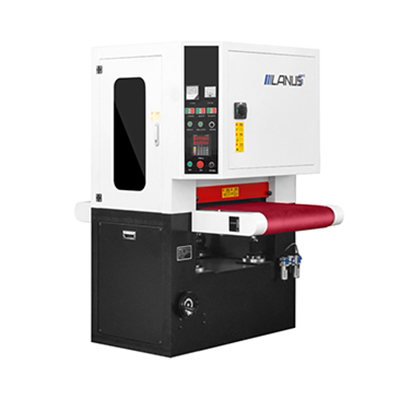
Fabrication shops must match their equipment to the metallurgical properties of their materials. Selecting between a dry and wet system impacts your production speed, facility footprint, and safety protocols.
A dry sanding machine excels in heavy-duty carbon steel applications. We rely on them for heavy slag removal, weld blending, and general edge deburring. Because they generate intense heat and airborne sparks, they require robust spark arrestors. High-velocity dust extraction is mandatory to pull hazardous particulates away from the operator's breathing zone. Dry systems are generally easier to install since they do not require plumbing.
Conversely, a wet sanding machine is mandatory for processing combustible metals. You must use wet systems for titanium, magnesium, and aluminum.
Features-to-Outcome: The continuous coolant application offers multiple operational benefits. It prevents warping on thin-gauge metals by dissipating frictional heat instantly. It extends belt life through constant lubrication, preventing the abrasive from loading up with soft metal shavings. Most importantly, it traps hazardous, explosive particulates in a safe liquid slurry.
When choosing the right system for production lines, evaluate your facility's infrastructure. Wet systems require specialized plumbing and coolant filtration systems. You must also account for environmental disposal compliance when handling coolant sludge. Dry systems demand higher initial ventilation investments. Use the chart below to guide your deployment strategy.
Decision Matrix: Dry vs. Wet Sanding Systems
Application Factor | Dry Sanding Systems | Wet Sanding Systems |
|---|---|---|
Primary Metals | Carbon steel, iron, alloy steel | Aluminum, titanium, magnesium |
Heat Management | Relies on ambient air and rapid passes | Flood coolant prevents thermal distortion |
Safety Focus | Spark arrestors and fire suppression | Slurry management and filtration |
Facility Needs | High-CFM dust collection | Plumbing, coolant tanks, waterproof PPE |
Industrial grinders remove solid steel in seconds. They will not hesitate to do the same to an operator's hand. Strict adherence to sanding machine safety protects your workforce and ensures ongoing OSHA compliance. Safety must integrate directly into your daily workflow.
Basic safety glasses are insufficient for industrial metal finishing. Operators must wear impact-resistant face shields compliant with ANSI Z87.1 standards. Heavy-duty leather aprons protect the torso from high-velocity sparks and thrown debris. Depending on the metal processed, assign appropriate respirators. N95 or P100 masks filter out microscopic metal dust effectively.
Strict Rule: Operators must remove all loose clothing, jewelry, or unrestrained hair. These easily tangle in high-speed belts. Furthermore, do not wear standard woven cotton or synthetic gloves. Woven fibers catch in the abrasive belt, forcefully pulling the operator’s hand into the machine's nip points. Use tight-fitting leather gloves or specialized tear-away variants instead.
Factory-installed guards protect operators from exposed wheels and drive belts. Ensure all guards remain bolted firmly in place during operation. Never expose more of the abrasive belt than absolutely necessary for the specific workpiece. Leaving wide sections of the belt unguarded invites catastrophic accidents. If a guard shows signs of damage, lock out the machine immediately.
Hand-feeding small metal parts poses significant risks. The aggressive abrasive can easily snatch small components out of an operator's grip. You must use specialized handling tools. Utilize custom jigs, heavy-duty push blocks, or magnetic grips for smaller components. These tools keep hands safely away from the contact wheel and flat platen. They also provide better leverage, resulting in a more uniform surface finish.
Relying on operator intuition leads to inconsistent batches and ruined materials. Standardizing your industrial sanding machine operation through step-by-step Standard Operating Procedures (SOPs) reduces material waste. It also extends machine lifespan by preventing abusive handling.
Clear the immediate work area of all debris and unnecessary tools.
Engage the motor and observe the belt path safely from a distance.
Listen for unusual bearing noises or belt slapping against the chassis.
Adjust tracking knobs immediately. The belt must run perfectly centered over the platen and contact wheels. Misaligned belts suffer from severe edge fraying and will snap prematurely.
Operators must understand how to apply force correctly. For manual feeding, apply consistent, even pressure. You must let the abrasive do the work. Forcing the metal aggressively against the belt causes massive heat buildup. This glazes the abrasive, melting the metal directly into the grit and ruining the belt.
For wide-belt conveyor systems, calibration requires precision. You must adjust the conveyor speed (feed rate) to match the depth of cut and the specific abrasive grit. A slow feed rate with a coarse grit causes severe gouging. A fast feed rate with a fine grit causes the machine to stall or the belt to slip.
Proper movement dictates the final aesthetic. Keep the workpiece moving laterally across the entire face of the belt. Holding a part stationary in one spot causes grooving in the abrasive and creates deep trenches in the metal. If you are dry sanding, quench the metal frequently in a water bucket. This maintains the material's metallurgical integrity and prevents heat distortion. Thin parts will warp severely if you skip quenching.
Even the most robust metal sanding machine degrades without routine care. Implementing a structured maintenance program prevents unexpected downtime. It also preserves the precision required for high-end fabrication.
Maintenance begins the moment the shift ends. Operators must release the belt tension mechanism before walking away. Leaving a machine under tension overnight stretches the belt backing. Worse, it creates permanent flat spots on rubber contact wheels. These flat spots cause severe vibration upon restart. Next, operators must clear all swarf and dust from the chassis, drive belts, and extraction ports. Accumulated metal dust ruins moving parts and creates a severe fire hazard.
Supervisors should inspect machines weekly for subtle degradation. Watch for signs of a glazed or "loaded" belt. If operators report reduced cutting efficiency or you notice burning smells, the abrasive is likely clogged. Inspect the contact wheels closely. Look for grooving or degrading urethane. A compromised contact wheel directly impacts sanding precision and makes achieving flat finishes impossible.
For teams evaluating a new equipment purchase, factor maintenance into your design criteria. Check the accessibility of grease points and tracking mechanisms. Complex maintenance often gets skipped. Simple, accessible designs ensure long-term usability and better compliance from your maintenance team. Always select machinery built for heavy industrial cycles rather than light hobbyist use.
Safe and efficient metal finishing requires marrying the right equipment configuration with rigorous operator discipline.
Calibrate your abrasive selection and tensioning daily to prevent rapid belt degradation and poor finishes.
Never bypass safety guards, and enforce strict PPE rules to mitigate severe pinch-point injuries and respiratory hazards.
Match your machine type (wet vs. dry) strictly to the combustibility and thermal limits of your primary metal stock.
Call-to-Action: Consult with applications engineers or request a test run with your specific metal components. This helps finalize your equipment selection and refine your facility's operational SOPs.
A: Belt lifespan varies heavily based on applied pressure, metal type, and grit breakdown. Change the belt immediately when you notice reduced cutting efficiency, excessive heat buildup, or burn marks on the metal. A glazed or "loaded" belt stops cutting and only creates dangerous friction.
A: We strongly advise against dual-use without total teardown cleaning. Mixing wood dust and hot metal sparks creates an extreme fire hazard within the extraction system. Smoldering wood dust can ignite hours after the machine powers down. Use dedicated machines for distinct materials.
A: Discoloration indicates excessive heat buildup. Troubleshoot these common factors: your belt speed might be too high, your feed rate too slow, or you are pressing too hard. Most often, the abrasive is dull or loaded. Switch to a fresh belt or a sharper ceramic grit.


